
Tracking connects the “same” objects or particles across time-lapse sequences. Because objects may appear, disappear, divide, or change shape between frames, they typically receive different object IDs on each frame. Tracking solves this by assigning each object a persistent track ID that remains constant across frames for the same physical entity.
Object tracking
GA3 provides two distinct tracking approaches optimized for different applications:
Object tracking
Tracking > Tracking > Track Objects is designed for larger, morphologically complex objects like cells. It:
Works directly with binary layers.
Uses object frame-to-frame overlap to assign track ID.
Handles objects that change shape between frames.
Combines easily with standard object measurements.
Is suitable when objects are morphing over time.
Tip
Use it for cells, organoids, cell clusters, tissue regions.
Particle tracking
Tracking > Tracking > Track Particles is optimized for point-like particles and includes motion modeling:
Works with centroid positions (not binary layers).
Uses position-based algorithms with motion prediction.
Offers different motion models (Brownian, directed).
Provides specialized motion analysis features.
Handles high particle densities efficiently.
Is suitable for small/rigid bodies.
Tip
Use it for vesicles, fluorescent spots, small organelles, diffusing molecules, single particles.
This guide covers three complete tracking workflows demonstrating both approaches:
Track moving objects - Object tracking combined with morphology measurements.
Particle tracking with motion analysis - Motion feature calculation and motility classification.
Single particle tracking with diffusion - Mean squared displacement (MSD) and diffusion coefficient analysis.
Common workflow structure
All tracking workflows share a similar pipeline structure:
Segmentation
Detect objects or particles in each frame independently using appropriate segmentation methods.
Position measurement
Extract time and position information for each detected object. It is required for particle tracking.
Append Object measurement (optional)
Append object/cell measurements to the track IDs. It is typical for object tracking.
Track accumulation
Collect all tracking data across the entire time-lapse using Tracking > Tracks > Accumulate Tracks, filtering for minimum track length.
Analysis and visualization
Calculate motion features, display trajectories, and present results in synchronized views.
This workflow tracks cells or large objects while simultaneously measuring their morphological features.
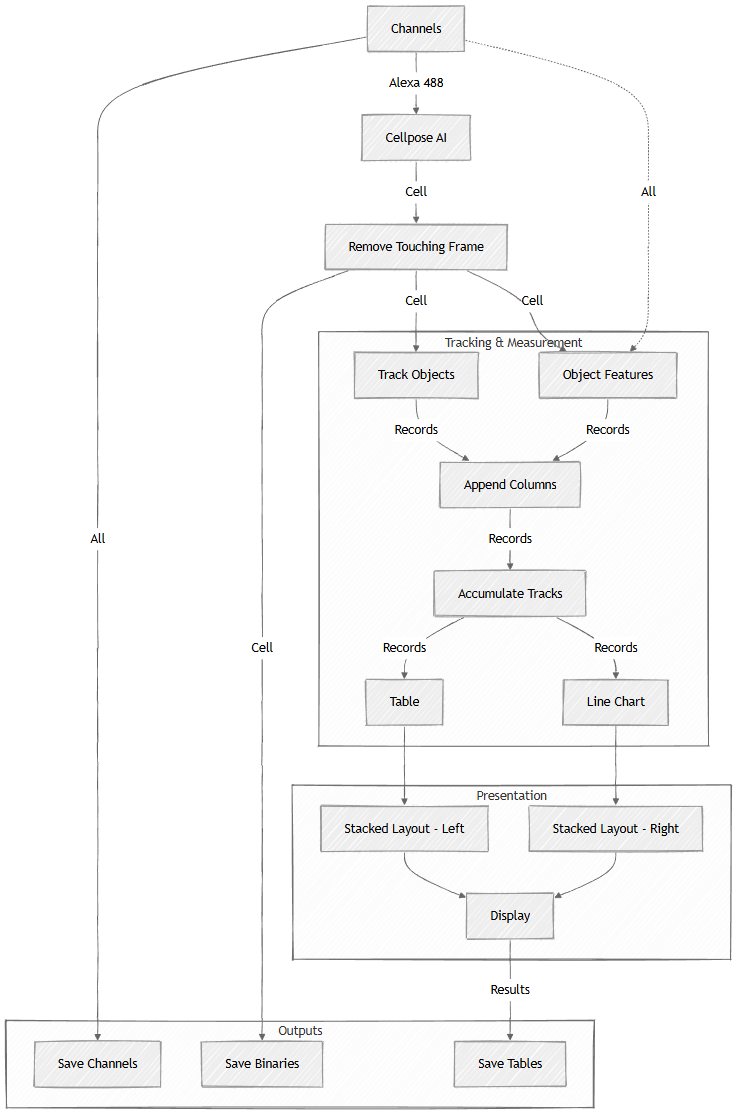
Figure 724. Schematic.
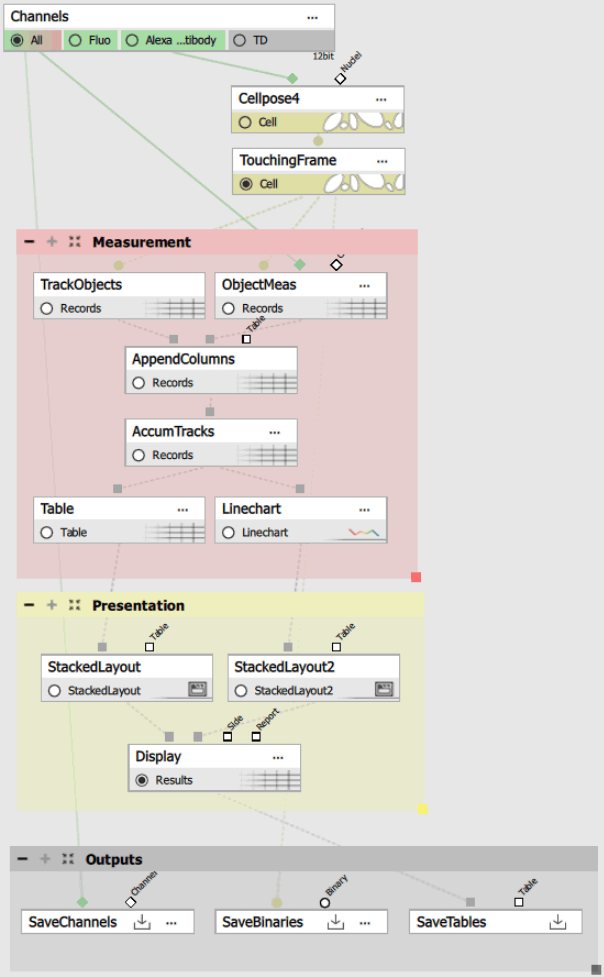
Figure 725. Recipe.
Segmentation with Cellpose
Segmentation > Special detections > Cellpose4 provides AI-powered cell segmentation on the fluorescent channel. The diameter parameter (35 pixels) is tuned for the typical cell size in the sample.
Border object removal
Binary processing > Remove objects > Touching Borders eliminates objects that touch the image border (5 pixel margin on all sides). This prevents tracking partial objects that enter or leave the field of view.
Note
Removing border objects is critical for accurate tracking. Incomplete cells at boundaries create artificial track starts and ends that distort statistics.
Object tracking
Tracking > Tracking > Track Objects assigns track IDs by matching objects between consecutive frames based on:
Overlap between object positions.
Similarity in size and shape.
Proximity when objects do not directly overlap.
The output is a Records table with:
TrackId: Persistent identifier for each tracked object.
Frame information: Time points where the object appears.
Object ID: Per-frame object number (changes each frame).
Object measurement
Object Features (Measurement > Basic > Object) measures morphological and intensity features for each tracked object:
Size: Area, perimeter.
Shape: Circularity, elongation, width, height.
Intensity: Mean, min, max, standard deviation in all channels.
Position: Centroid X, Y coordinates.
Combining tracking with measurements
Data manipulation > Basic > Append Columns merges the track IDs from Track Objects with the measured features from Object Features. Both tables have the same rows (one per object per frame), making the combination straightforward.
This creates a unified table where each object has:
Its morphology and intensity measurements.
Its track ID linking it across time.
All temporal information.
Track accumulation and filtering
Tracking > Tracks > Accumulate Tracks collects tracks across all frames with filtering:
MinSegmentCount: 3 frames minimum.
Tracks appearing in fewer frames are discarded as transient noise.
The accumulated data organizes objects by track, enabling temporal analysis of individual cells throughout the time-lapse.
Visualization
Line Chart displays trajectories color-coded by track, showing how each cell moves over time. The chart can plot any measured feature vs. time (area changes, intensity variations, etc.).
Table shows all tracks with measurements at each time point, allowing sorting by track ID or any measured parameter.
Results
This workflow produces:
Track IDs linking objects across time.
Complete morphological measurements for each tracked object.
Trajectory visualizations.
Combined segmentation masks and measurement tables.
Use cases
Cell migration tracking, cell growth analysis, morphology changes during differentiation, long-term single-cell analysis.
This workflow focuses on motion characterization, classifying particles by their motility patterns and measuring detailed motion features.
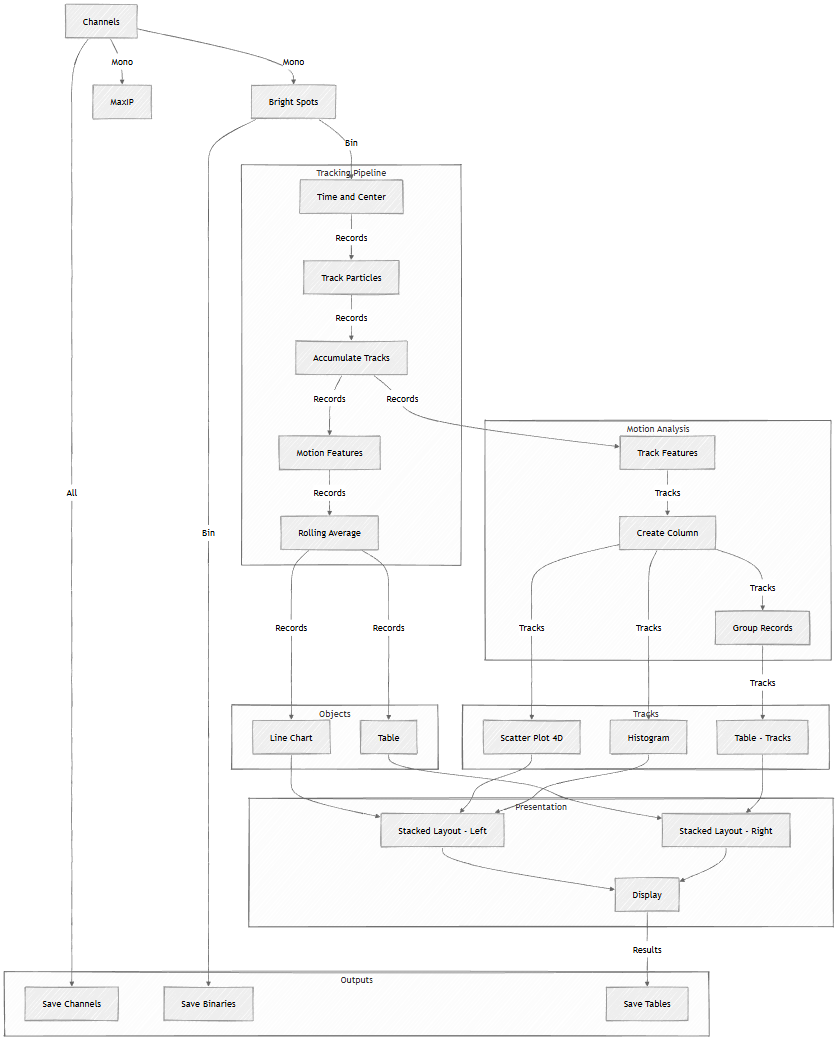
Figure 726. Schematic.
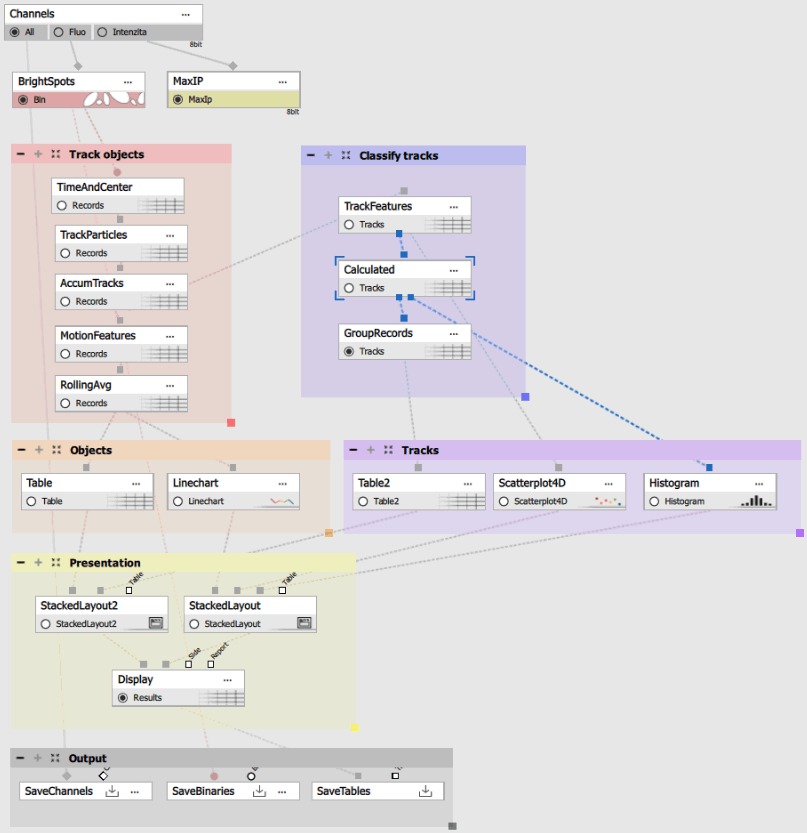
Figure 727. Recipe.
Spot detection
Segmentation > Spot detections > Bright Spots detects fluorescent particles with:
Diameter: 9 microns (adjusted for particle size).
Contrast: 18 (threshold for minimum brightness).
This produces a binary layer with detected spots in each frame.
Maximum intensity projection
ND Processing & Conversions > Stack reduction > Max IP creates a composite image showing all particle positions throughout the time-lapse. This is an aid to show how the tracks align with actual positions.
Time and position measurement
Tracking > Object Position > Time & Center measures for each detected particle:
Time: Timestamp of the frame.
CenterX, CenterY: Centroid coordinates.
This table of positions becomes the input for particle tracking.
Particle tracking algorithm
Tracking > Tracking > Track Particles connects particles between frames using parameters:
maxSpeed: 1000 µm/frame - maximum distance a particle can move between frames.
maxGap: 2 frames - allows tracking through temporary particle disappearance.
motionModel: 1 (directed motion) - assumes particles have momentum.
The algorithm predicts where each particle should appear in the next frame based on its previous motion, enabling accurate tracking even in crowded fields.
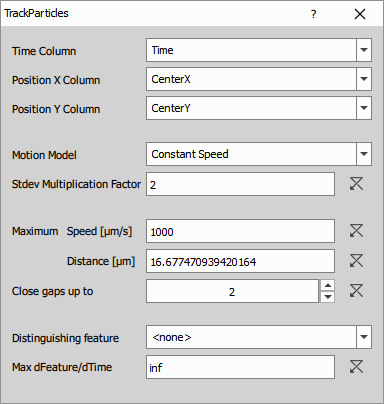
Figure 728.
Track accumulation
Tracking > Tracks > Accumulate Tracks collects all tracks with:
MinSegmentCount: 4 frames minimum.
Filters out short, unreliable tracks.
Motion feature calculation
Tracking > Tracking Features > Tracking Features > Motion Features calculates instantaneous motion parameters for each segment (position to position):
Speed: Distance per time interval.
Direction: Heading angle.
Acceleration: Rate of speed change.
These frame-to-frame measurements capture motion dynamics.
Rolling average smoothing
Data manipulation > Processing > Rolling Average smooths noisy motion features over a window of frames. This reduces measurement noise while preserving real motion trends.
Track feature calculation
Track Features (Tracking Features) computes track-level summary statistics:
Per-track features:
Segments: Number of frames in the track.
Length: Total path length traveled.
Duration: Time span of the track.
Speed: Mean, min, max speed.
Heading: Overall direction consistency.
Acceleration: Mean acceleration magnitude.
LineLength: Straight-line distance from start to end.
LineSpeed: Displacement divided by duration.
Straightness: LineLength / Length (1 = perfectly straight, 0 = highly curved).
These aggregate features characterize the overall behavior of each particle.
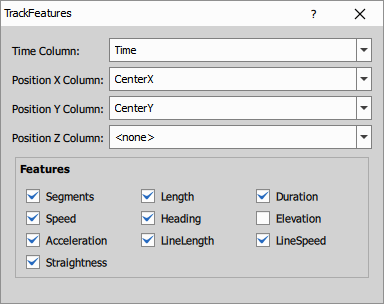
Figure 729.
Motility classification
Data manipulation > JavaScript > JS Create Column creates a calculated column classifying tracks by motility:
Classification logic:
Speed < 30 ? "STEADY" : (Straightness < 0.4 ? "MOTILE" : "PROGRESSIVE");
This produces three categories:
STEADY: Low speed, minimal movement (confined or stationary)
MOTILE: Higher speed but non-directional (random/diffusive motion)
PROGRESSIVE: High speed and directional (directed migration)
The thresholds are adjusted based on the biological system.
Group by motility
Data manipulation > Grouping > Group Records aggregates tracks by their motility classification, producing summary statistics for each category (count, mean speed, mean straightness, etc.).
Visualization
Displays individual particle trajectories color-coded by track.
Shows tracks as points in multidimensional feature space (speed vs. straightness, colored by motility class), revealing population structure.
Shows the distribution of tracks across motility categories (how many steady vs. motile vs. progressive).
Display both per-frame motion data and per-track summaries.
Results
This workflow produces:
Track IDs for all particles.
Instantaneous motion features (speed, direction, acceleration).
Track summary features (length, duration, straightness).
Motility classification.
Population statistics by motility class.
Use cases
Vesicle transport analysis, cell migration modes, drug effects on motility, distinguishing active vs. passive transport.
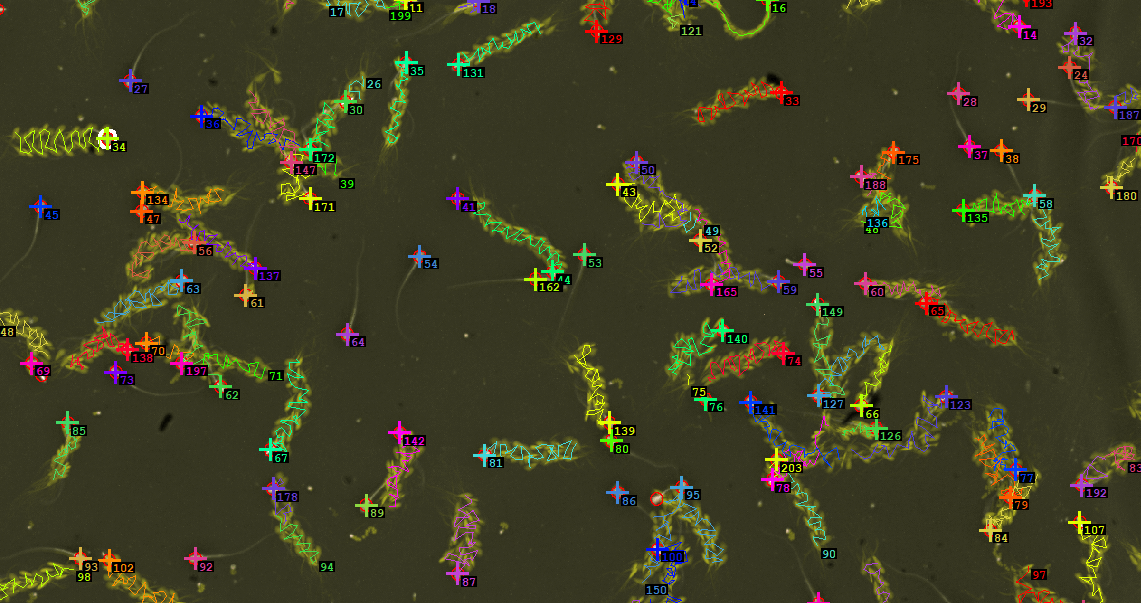
Figure 730.
This specialized workflow calculates mean squared displacement (MSD) to determine diffusion coefficients, essential for studying Brownian motion and molecular diffusion.
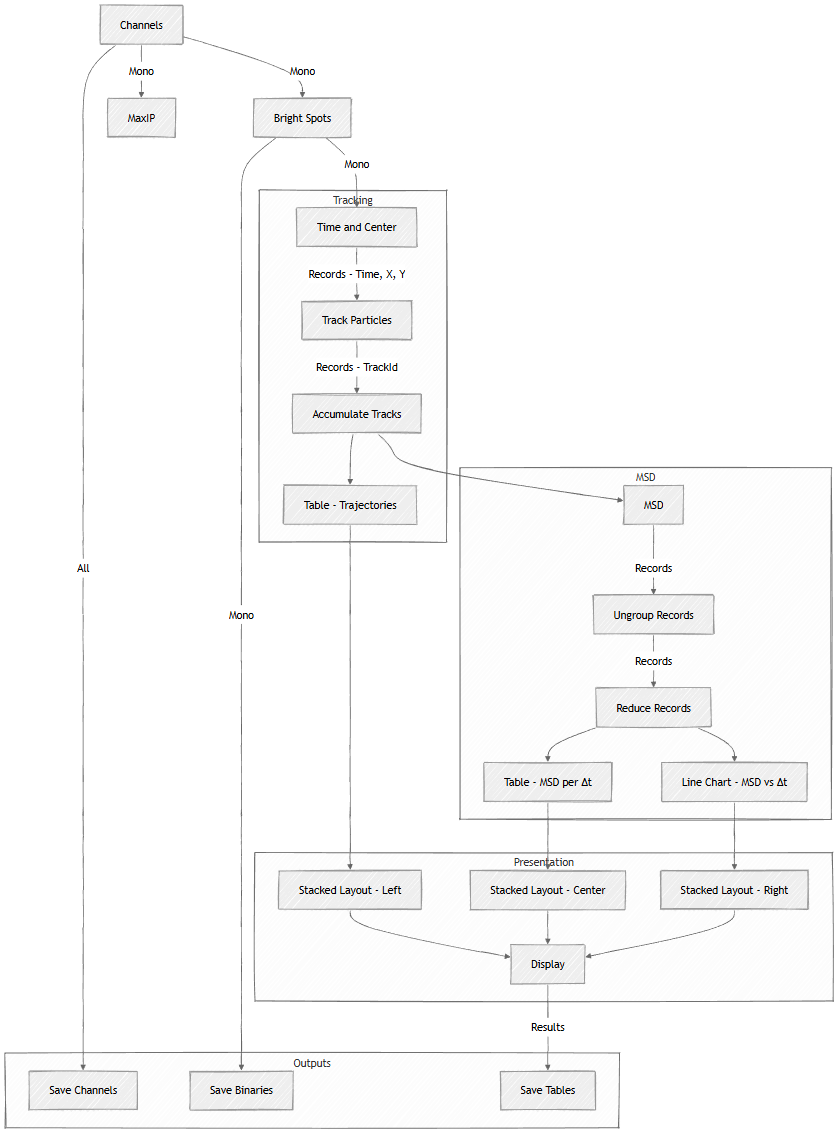
Figure 731. Schematic.
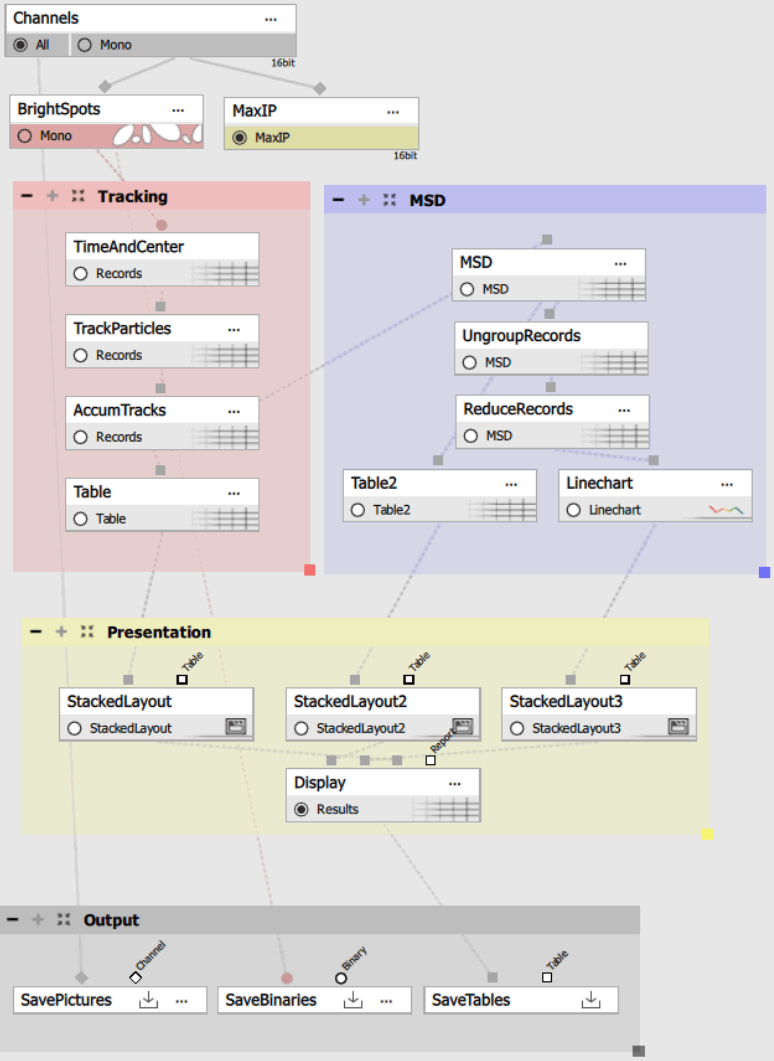
Figure 732. Recipe.
High-contrast spot detection
Segmentation > Spot detections > Bright Spots detects single fluorescent molecules or particles with stringent settings:
Diameter: 0.69 microns.
Contrast: 500 (high threshold for bright, well-isolated spots).
Intensity filters: Remove outliers.
These strict criteria ensure only well-localized particles are tracked, critical for accurate diffusion analysis.
Note
Single particle tracking requirements:
High signal-to-noise ratio.
Isolated particles (no overlap).
Fast acquisition (short time intervals).
Stable focus throughout acquisition.
Poor localization accuracy will produce incorrect diffusion coefficients.
Tracking for diffusion analysis
Tracking > Tracking > Track Particles uses settings optimized for diffusive motion.
Parameters:
maxSpeed: 4 µm/frame (tight constraint for slowly diffusing particles).
maxGap: 2 frames.
motionModel: 0 (Brownian motion) - assumes random walk.
stdevFactor: 2.5 - statistical tolerance for position prediction.
The Brownian motion model is essential for diffusion studies as it does not assume directional bias.
Long track accumulation
Tracking > Tracks > Accumulate Tracks requires:
MinSegmentCount: 20 frames minimum.
Long tracks are necessary for reliable MSD curve fitting. Shorter tracks don’t provide enough data points for accurate diffusion coefficient calculation.
Mean squared displacement calculation
Tracking > Tracks > MSD computes the mean squared displacement for each track:
MSD formula:
MSD(Δt) = <[r(t + Δt) - r(t)]²>
Where:
Δt: Time interval (lag time).
r(t): Position at time t.
< >: Average over all time points and all tracks.
The MSD is calculated for increasing time intervals:
Δt = 1 frame: MSD between consecutive positions.
Δt = 2 frames: MSD between positions 2 frames apart.
Δt = 3 frames: MSD between positions 3 frames apart.
and so on …
Output table structure:
Δt: Time interval.
MSD: Mean squared displacement at this interval.
StDev: Standard deviation of MSD.
Count: Number of measurements contributing to this point.
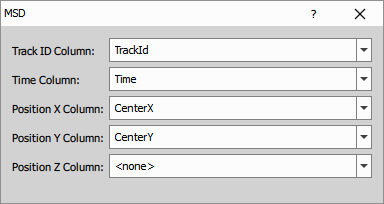
Figure 733.
MSD data processing
Ungroup Records separates the grouped MSD data structure for further analysis.
Reduce Records aggregates MSD values across all tracks, computing:
Mean MSD: Average MSD at each time lag (the ensemble MSD).
Count of tracks: Number of tracks contributing.
This produces the final MSD curve for the entire population.
MSD curve visualization
Line Chart plots MSD vs. Δt, displaying:
The characteristic MSD curve shape.
Error bars showing variability.
Linear or non-linear regime.
Curve interpretation:
Linear MSD(Δt) ∝ Δt: Normal diffusion (Brownian motion).
MSD(Δt) ∝ Δt^α, α < 1: Subdiffusion (confined or hindered).
MSD(Δt) ∝ Δt^α, α > 1: Superdiffusion (active or directed).
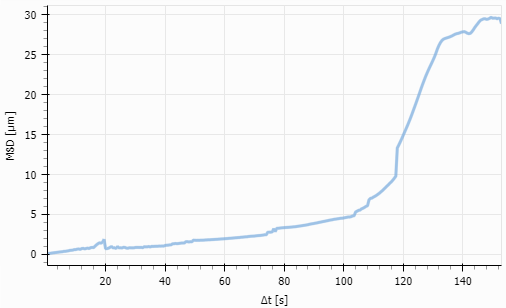
Figure 734.
Diffusion coefficient calculation
For normal diffusion, the relationship is:
MSD(Δt) = 4D·Δt (2D motion)
Where D is the diffusion coefficient.
The slope of MSD vs. Δt gives: Slope = 4D
Therefore: D = Slope / 4
The diffusion coefficient units are typically µm2/s.
Fitting procedure:
Fit a linear regression to the initial linear region of the MSD curve (typically first 25% of time lags).
Extract the slope.
Calculate D = Slope / 4.
Note
Why only fit the initial region? At long time lags:
Fewer data points (reduced statistics).
Boundary effects from finite imaging area.
Photobleaching effects.
Track-to-track variations become dominant.
The initial linear region provides the most reliable diffusion coefficient.
Results interpretation
Tables display:
Per-track MSD curves.
Ensemble-averaged MSD.
Track counts at each time lag.
Diffusion analysis outputs:
Diffusion coefficient (D).
Diffusion mode (normal, sub-, or super-diffusion).
Track statistics (number of tracks, track lengths).
Use cases:
Molecular diffusion in membranes.
Protein mobility in cells.
Nanoparticle diffusion.
Drug molecule tracking.
Lipid raft dynamics.
Receptor diffusion studies.
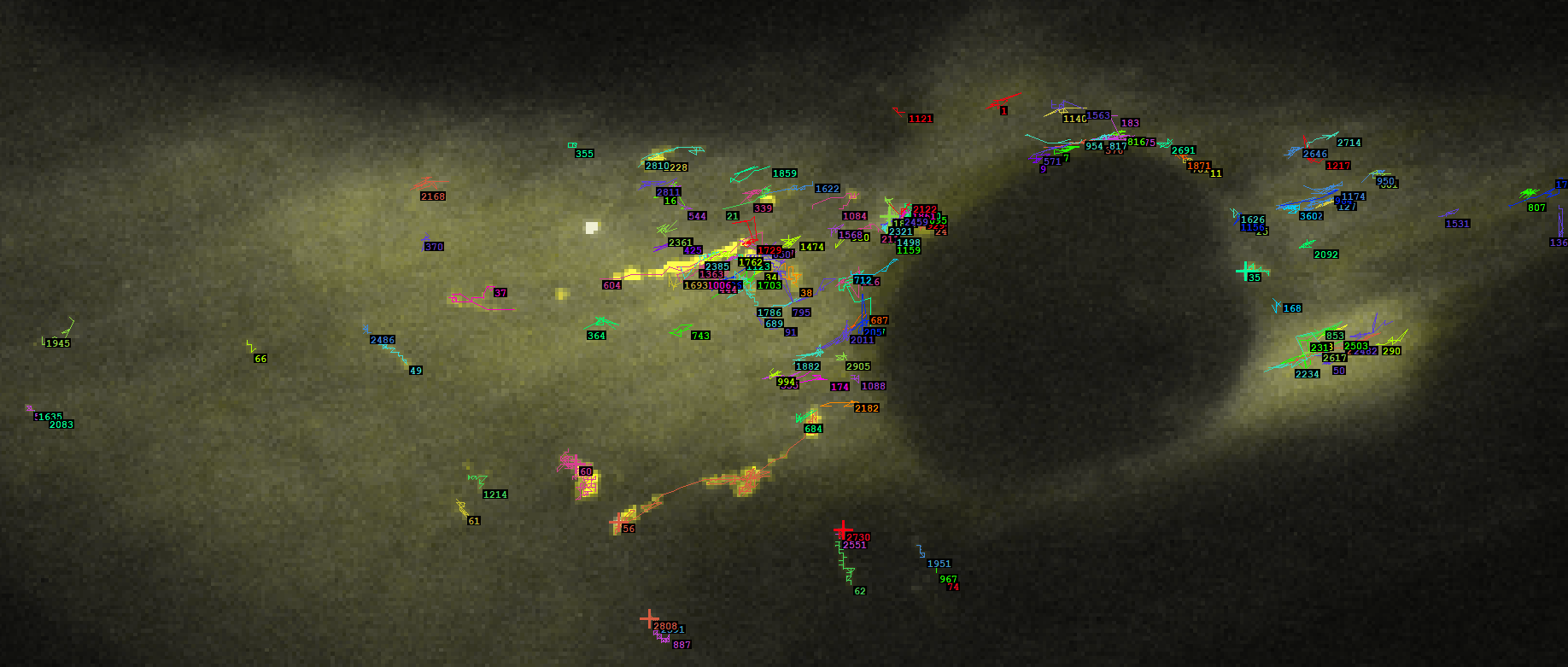
Figure 735.
Table 20. When to use each workflow.
| Workflow | Best for | Key output | Typical application |
|---|---|---|---|
| Track moving objects | Cells, large objects | Track ID + morphology | Cell migration, growth, division tracking |
| Particle tracking + motion | Vesicles, organelles | Motion features + classification | Transport analysis, motility screening |
| Single particle + MSD | Molecules, nanoparticles | Diffusion coefficient | Membrane dynamics, molecular mobility |
Table 21. Parameter comparison.
| Parameter | Moving Objects | Particle Motion | Single Particle MSD |
|---|---|---|---|
| Segmentation | Cellpose (AI) | Bright Spots | Bright Spots (strict) |
| Tracking method | Track Objects | Track Particles | Track Particles |
| Motion model | Shape-based | Directed (1) | Brownian (0) |
| Min track length | 3 frames | 4 frames | 20 frames |
| Key analysis | Morphology | Motion features | MSD curve |
Common tracking challenges
Track fragmentation
Problem: Tracks break into multiple segments instead of continuous trajectories.
Causes:
Objects disappearing temporarily (out of focus, low signal).
Detection failures in some frames.
maxGap too small.
Solutions:
Increase maxGap parameter (allow longer disappearance).
Improve segmentation quality.
Optimize acquisition (better focus, higher frame rate).
Incorrect track assignment
Problem: Tracks switch between objects (ID swapping).
Causes:
Objects too close together.
maxSpeed too large (allows impossible jumps).
Similar object appearance.
Solutions:
Reduce object density (lower seeding).
Decrease maxSpeed for more conservative linking.
Use object shape information (Track Objects instead of Track Particles).
Too many short tracks
Problem: Most tracks only last a few frames.
Causes:
High object turnover (appearing/disappearing).
Poor segmentation consistency.
Photobleaching.
Solutions:
Increase MinSegmentCount to filter short tracks.
Improve segmentation robustness.
Reduce imaging intensity to minimize photobleaching.
For MSD: reduce required MinSegmentCount if necessary, but interpret results cautiously.
Missing tracks at image boundaries
Problem: Tracks end when objects reach image edges.
Causes:
Objects leaving field of view.
Border effects in tracking.
Solutions:
Use Remove Touching Frame to exclude border objects.
Acquire larger field of view.
Track only central region if migration is non-directional.
Experimental design
Imaging parameters:
Frame rate: Fast enough to capture motion (maxSpeed/2 is a guideline).
Total duration: Long enough for meaningful statistics (10-20x typical track length).
Field of view: Large enough to capture full trajectories.
Z-position: Maintain focus (use autofocus for long acquisitions).
Sample preparation:
Density: Moderate density (avoid overcrowding).
Labeling: Bright, stable fluorophores.
Media: Minimize drift and evaporation.
Tracking parameter optimization
Iterative approach:
Start with default parameters.
Visualize tracks overlaid on images.
Identify problems (fragmentation, swapping, missing tracks).
Adjust parameters accordingly.
Re-run and verify improvement.
Key parameters to tune:
maxSpeed: Set to 1.5-2× maximum expected speed.
maxGap: Start with 2, increase if detection is inconsistent.
MinSegmentCount: Balance between statistics and data retention.
Quality control
Verify tracking quality:
Visual inspection of trajectories on images.
Check track length distribution (should have a clear peak).
Monitor track start/end events (should not all be at boundaries).
Compare forward and backward tracking (should give similar results).
For MSD analysis:
Examine individual track MSDs before averaging.
Verify linearity in the initial region.
Check that enough tracks contribute to each time lag.
Compare D values across replicates for consistency.
3D tracking
All tracking methods extend to 3D with appropriate inputs:
Use 3D segmentation (Bright Spots 3D, Threshold 3D).
Track Particles works with X, Y, Z coordinates.
MSD formula becomes: MSD(Δt) = 6D·Δt (3D motion).
Multi-color tracking
Track particles in multiple channels simultaneously:
Segment each channel separately.
Track each population independently.
Analyze interactions between populations.
Tracking with division
For cells that divide:
Use specialized cell tracking nodes.
Track lineage relationships (mother-daughter).
Analyze division timing and frequency.
Confined diffusion analysis
For MSD curves showing plateaus:
Fit confined diffusion models.
Extract confinement radius.
Determine confinement strength.
Exporting and further analysis
Results can be exported for external analysis:
Track data:
Full trajectory tables (X, Y, time, track ID).
Track summary statistics.
Motion feature tables.
For publications:
High-resolution trajectory images.
MSD curves with error bars.
Statistical comparisons between conditions.
Table 22. Troubleshooting summary.
| Issue | Likely cause | Solution |
|---|---|---|
| Tracks too short | Segmentation inconsistent | Improve segmentation, increase maxGap |
| Track swapping | Objects too close | Reduce density, decrease maxSpeed |
| Missing tracks | Detection failures | Optimize segmentation threshold |
| Non-linear MSD | Not normal diffusion | Use appropriate diffusion model |
| Noisy motion features | Low temporal resolution | Use rolling average smoothing |
| Few tracks survive filtering | MinSegmentCount too high | Reduce minimum track length |